The last few years’ focusing on working with sporting organisations on their social impact has led to some of the most creatively fulfilling work of my career. Both sport and arts deliver enormous economic and social benefits to society and when they riff off each other, what’s not to love?
When Kofi Anan said ‘Culture can change!’ he was referring to the ability of culture to change. It is equally true though that culture – as in the arts – has the ability to change society. Below are a few examples.
I’ve found new ways to tell stories. I’ve done this by asking different people to tell their story and finding new ways to tell a story. As Manchester’s heritage lead on the Women’s Euros I recruited and trained a team to deliver new footballing stories. These are archived FOREVER in the archives of the National Football Museum and a selection were showcased in the 2022 Crossing the Line exhibition.
One of these was with Kerry Davis, a former England international who played 82 times for England and also played for Lazio way before Gazza and yet is too unknown and too uncelebrated. She is also the first player of dual heritage to play for England women. Her testimony about the awful (boggy) England pitch for the final for the 1984 Women’s Euros illustrates the lack of investment in women’s football. Following our collaboration she has been inducted into the national Football Museum’s Hall of Fame.
Another interviewee Angela Gallimore talked of waterlogged pitches in her 21 seasons playing – which included the 1984 and 1987 Women’s Euros.
Patricia Gregory talked about the story from a different angle – not as a player but as an administrator. Patricia was one of the founding members of the Women’s FA and worked to develop the game ‘as a hobby’ (her words used wryly- because she was unpaid- I’d describe it as ‘pro-bono’) alongside a career in broadcasting. Watch her interview here if the embedded video below doesn’t work in your browser.
Other interviewees were with the generation standing on their shoulers: the three Icelandic 11 year old girls playing on the pitch in Manchester City Centre Fan Zone was one of 50+ interviews with the general public. Their team in Iceland had recently had recently won a national competition and one had been named player of the tournament. They talked confidently about plans for their sporting futures that would not have been possibilities just ten years’ before.
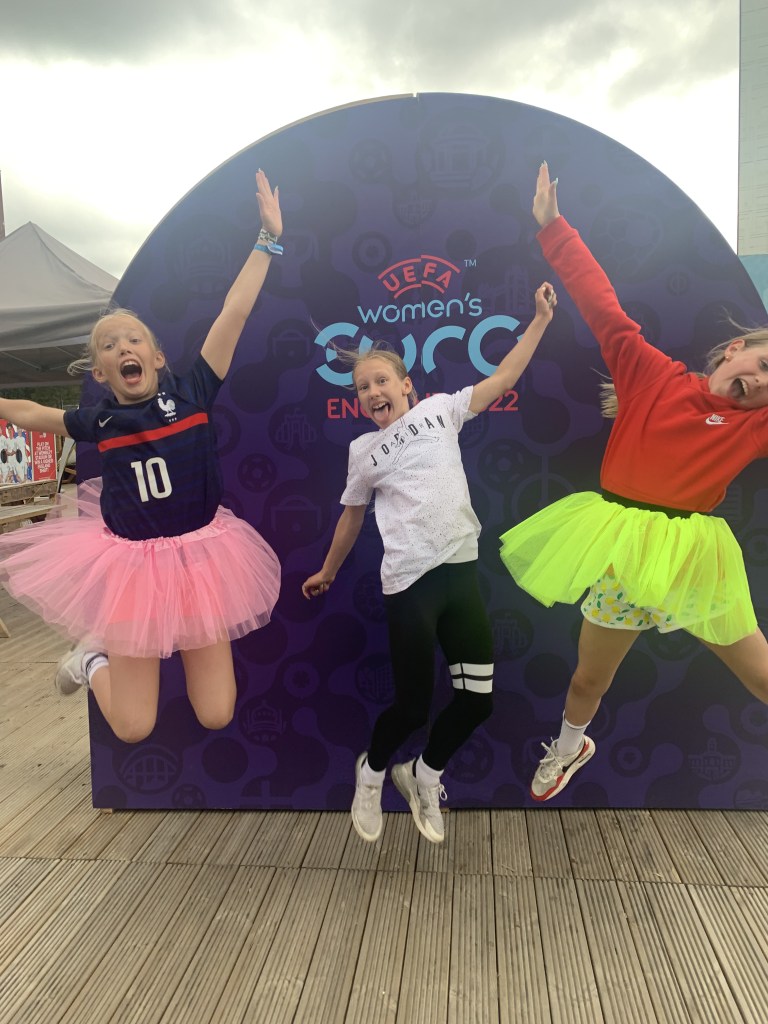
This photo was one of hundreds taken by project volunteers and project partner Getty to showcase new faces in football. The National Football Museum has a target of gender parity in its staffing, collections and archives and these interviews and photos proved a non-tokenistic way to add to this. I hope the fan zone interviews will be used in future bids to bring tournaments to Manchester and the UK.
I was prevented from playing football on the school pitch because I was a girl and aged 9 years I delivered a speech at a school assembly pleading for change which successfully changed the school rules and has been displayed in the People’s History Museum. This meant that running an engagement activity at a women and girl’s football event organised by Manchester FA with 170 players in Wythenshawe was a high point of our city’s celebrations and the collaboration between the museum and the wider community. Change!
Collectively – with an anthems project, exhibitions, photos and interview project the FA project has been measured to have an enormous impact: it reached over 4.5 million people across 10 host cities including 408,594 visitors tomuseum exhibitions and has had an enormous societal impact on the popularity of women’s football and on the lives of the previously uncelebrated 227 women who played for England between 1972 and 2022. In Manchester I coordinated 7 Fan Party heritage events which were a community joy.
Switching subjects: change has happened for the better for our country’s LGBT+ community but it has been hard fought-for and it’s not over. As an ally to the LGBT+ community I recognise that we can work for change by celebrating positives and role models as well as fighting against injustice.
In 2021 I created our city’s first ever LGBT+ history bike tour for LGBT+ History Month. After doing desk research, I reached out to the Manchester LGBT+ community to ask for personal recollections and to ask for suggestions – something I repeat annually to keep the tour fresh. I’ve developed the tour by collaborating with two LGBT riding groups and a charity working with refugees and asylum seekers from the LGBT community. The tour visits sites of activism, of commemoration and celebrates key figures in the LGBT+ community. Key outcomes are increased community pride, raising of awareness and funds for a small charity and a new creative tour.

My other tours have included an Ancoats and Northern Quarter walking tour for societal innovation academics and artists and the first inception of an Irwell Sculpture trail bike tour. Watch this space for a more developed version having sought input from Bury Art Gallery.
Current collaborations are in the works – with Ramsbottom Heritage Society, one building on the Mass Observation project started in Bolton in the 1930s. It’s all about collaboration and community.
If you’d like to explore a collaboration or talk about a project for me to manage or produce, get in touch.

 Communications that change the world