So 2026 has brought the start of a fabulous programme of work as the communications lead for Preston Moves. Having spent yesterday developing the key messages – here they are! [Images are incoming! The design agency has been briefed and I’ll brief the photographer as soon as we have ‘models’.]
Preston Moves is a city-wide partnership working with communities to create a movement for active living.
It’s a collaboration between local organisations who know their communities well and is prioritising areas where people face the biggest barriers to being active.
Our work is starting in Deepdale, St Matthew’s, Fishwick & Frenchwood, and Ribbleton where civic, community and faith leaders have asked us to focus on how we are supporting children and young people; whether our community spaces make it easy for people to be active; how activity supports community health and care, and how we can communicate about movement in a way that encourages, rather than alienates, people.
In 2026 we will be working with communities to understand what’s already happening locally, what helps people move more, and what gets in the way.
And we’re supporting community leaders with free training to help them feel more confident in leading and coordinating work.
Preston Moves is supported by Sport England and coordinated by a team from Preston City Council, Active Lancashire, leisure services provider GLL, Lancashire and Cumbria NHS Integrated Care Board, Preston North End Community and Education Trust and communications agency These Four Words.
If you’re part of a community group in our priority areas, we want to collaborate. Get in touch with programme manager Amy Thompson-Spears on a.thompson-spears@preston.gov.uk to start the conversation or watch this video invitation to our engagement with community groups.
The last few years’ focusing on working with sporting organisations on their social impact has led to some of the most creatively fulfilling work of my career. Both sport and arts deliver enormous economic and social benefits to society and when they riff off each other, what’s not to love?
When Kofi Anan said ‘Culture can change!’ he was referring to the ability of culture to change. It is equally true though that culture – as in the arts – has the ability to change society. Below are a few examples.
I’ve found new ways to tell stories. I’ve done this by asking different people to tell their story and finding new ways to tell a story. As Manchester’s heritage lead on the Women’s Euros I recruited and trained a team to deliver new footballing stories. These are archived FOREVER in the archives of the National Football Museum and a selection were showcased in the 2022 Crossing the Line exhibition.
One of these was with Kerry Davis, a former England international who played 82 times for England and also played for Lazio way before Gazza and yet is too unknown and too uncelebrated. She is also the first player of dual heritage to play for England women. Her testimony about the awful (boggy) England pitch for the final for the 1984 Women’s Euros illustrates the lack of investment in women’s football. Following our collaboration she has been inducted into the national Football Museum’s Hall of Fame.
Lioness Kerry Davis copyright National Football Museum
Another interviewee Angela Gallimore talked of waterlogged pitches in her 21 seasons playing – which included the 1984 and 1987 Women’s Euros.
Lioness Angela Gallimore copyright National Football Museum
Patricia Gregory talked about the story from a different angle – not as a player but as an administrator. Patricia was one of the founding members of the Women’s FA and worked to develop the game ‘as a hobby’ (her words used wryly- because she was unpaid- I’d describe it as ‘pro-bono’) alongside a career in broadcasting. Watch her interview here if the embedded video below doesn’t work in your browser.
First secretary of the Women’s FA, Patricia Gregory copyright National Football Museum
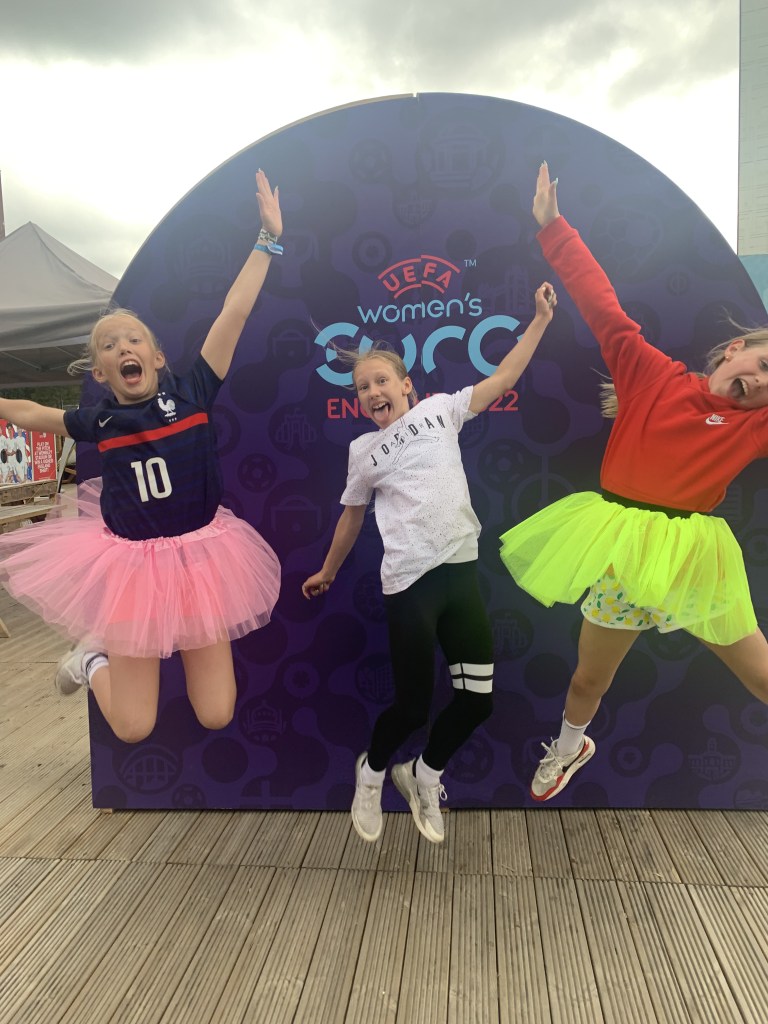
Other interviewees were with the generation standing on their shoulers: the three Icelandic 11 year old girls playing on the pitch in Manchester City Centre Fan Zone was one of 50+ interviews with the general public. Their team in Iceland had recently had recently won a national competition and one had been named player of the tournament. They talked confidently about plans for their sporting futures that would not have been possibilities just ten years’ before.
Jumping for Joy – copyright National Football Museum
This photo was one of hundreds taken by project volunteers and project partner Getty to showcase new faces in football. The National Football Museum has a target of gender parity in its staffing, collections and archives and these interviews and photos proved a non-tokenistic way to add to this. I hope the fan zone interviews will be used in future bids to bring tournaments to Manchester and the UK.
I was prevented from playing football on the school pitch because I was a girl and aged 9 years I delivered a speech at a school assembly pleading for change which successfully changed the school rules and has been displayed in the People’s History Museum. This meant that running an engagement activity at a women and girl’s football event organised by Manchester FA with 170 players in Wythenshawe was a high point of our city’s celebrations and the collaboration between the museum and the wider community. Change!
Collectively – with an anthems project, exhibitions, photos and interview project the FA project has been measured to have an enormous impact: it reached over 4.5 million people across 10 host cities including 408,594 visitors tomuseum exhibitions and has had an enormous societal impact on the popularity of women’s football and on the lives of the previously uncelebrated 227 women who played for England between 1972 and 2022. In Manchester I coordinated 7 Fan Party heritage events which were a community joy.
Switching subjects: change has happened for the better for our country’s LGBT+ community but it has been hard fought-for and it’s not over. As an ally to the LGBT+ community I recognise that we can work for change by celebrating positives and role models as well as fighting against injustice.
In 2021 I created our city’s first ever LGBT+ history bike tour for LGBT+ History Month. After doing desk research, I reached out to the Manchester LGBT+ community to ask for personal recollections and to ask for suggestions – something I repeat annually to keep the tour fresh. I’ve developed the tour by collaborating with two LGBT riding groups and a charity working with refugees and asylum seekers from the LGBT community. The tour visits sites of activism, of commemoration and celebrates key figures in the LGBT+ community. Key outcomes are increased community pride, raising of awareness and funds for a small charity and a new creative tour.
Pride Ride 2022 photo copyright Sarah Galligan
My other tours have included an Ancoats and Northern Quarter walking tour for societal innovation academics and artists and the first inception of an Irwell Sculpture trail bike tour. Watch this space for a more developed version having sought input from Bury Art Gallery.
Current collaborations are in the works – with Ramsbottom Heritage Society, one building on the Mass Observation project started in Bolton in the 1930s. It’s all about collaboration and community.
If you’d like to explore a collaboration or talk about a project for me to manage or produce, get in touch.
The impact report of the Ruby League World Cup 21 was launched last week and its comprehensive nature means it’s a lesson in the planning and measuring of outcomes and impact. Well done to the team.
The impact of sport in a community is incredible. Sport is a community superpower and an economic superpower and by choosing how we set-up a sporting tournament or how a club engages with its community we can choose who receives the social and economic benefit.
How you can use the report:
The report evidences the tournament’s role in levelling up the north, in leveraging funding, in connecting communities. It illustrates how a tournament can work on long-term societal issues through collaborations – and it gives commercially-useful data on viewership and match-attendance – plus incredibly strong lessons in inclusion. I felt quite emotional reading some of the case studies that stand alongside the data (on inclusive volunteering in particular.)
The report gave me the opportunity to learn more about the creative programme – something I hadn’t heard enough about at the time. Just like the WEUROS 22 (which had a *much* bigger creative programme) it worked through libraries and local events but the RLWC programme was focused on offering communities to develop skills through the Arts. I’m a big believer in social inclusion via the Arts and I think I’d still like to learn more about their ’deep’ rather than (solely) ‘broad’ activity here. (There shouldn’t be embarrassment about depth over breadth though I appreciate funders-demands).
As someone who is open about having suffered from depression, (what a big gang we are) I’ve long-loved the focus on mental health, or mental fitness as the tournament termed it to encourage the view that mental health, like physical health can go up and down. I’d encourage you to look at the report to see how the programme was delivered and measured.
The tournament team achieved their goal in being the biggest, best and most inclusive RLWC ever and the 108 page report is a good testament to why they believe this.
OMG what a tournament!!!! And whatever the result on Sunday I’m celebrating working on one of the most worthwhile and personal projects I’ve ever been part of within a clever and committed team at the National Football Museum, a city-wide team of event planners, Local Authority enablers, football legends and an FA team spanning the country.
As always with the work I enjoy the most it involves me being part of something bigger than me.
The heritage project I’m project managing for Manchester is an FA initiative funded by the National Lottery Heritage and Arts Council which is designed to celebrate new voices in the women’s game – this includes now-retired women’s football players including Lionesses – and fans – as well as young players.
I’m absolutely privileged to work on this within the National Football Museum.
So far my team have interviewed 9 ex players and about 40 fans in the Fan Zone and we’re hosting two story and memorabilia collection days at the National Football Museum this Sunday and 10 August. We’ve already hosted so many community days and events. We’ve played our part.
Football was my first sport – the one I was banned from playing at my school and working on this project has enabled me to *really* see the change that’s been made in my lifetime. Being at the opening game at Old Trafford with to my dad was awesome – but so was the ‘See it to Believe it festival’ organised by Olivia Laker at Manchester FA where 550 + girls and women were playing on fabulously-maintained pitches in Wythenshawe in South Manchester. I asked one of the under 10s how her last game went. ‘I did a Beth Mead!!!!!,’ she delighted.
I didn’t have female role models growing up.
So whilst the tournament continues, so does our work at the National Football Museum. We’re processing our interviews so they become part of October’s Crossing the Line exhibition Part 2 and so that the archives of the museum become more gender balanced in line with the museum’s 50-50 target.
I’m working tirelessly – and the fact I believe my work is making a difference – and I’m working with a great team makes me feel so very, very privileged.
I seem to have spent this year talking about the value of grassroots sport within the contect of global competitions. It’s incredible.
This year I worked on the Rugby League World Cup looking at the communication of their social impact programme – and I am currently working at the National Football Museum on Manchester’s arts and heritage programme for July’s Women’s Euros. As footbally was my first sport, this is very exciting.
Having always been sporty and having worked in CSR for twenty years+ taking my CSR learnings and community engagement focus into sport feels natural. I believe in its value – and that’s without the research funded by Sport England showing the ROI on grassroots sport as 3.91.
I am full of admiration for Jon Dutton’s leadership of the Rugby League World Cup and of the robust social impact programme’s he and the organisation’s Head of Social Impact, Tracy Power, is leading. Both of them believe passionately in the power of sport to reach commuities. And both of them know it’s not just in CSR programmes that an organisation makes a difference. It’s in the makeup of the organisation itself.
The decision to hold women’s men’s and wheelchair rugby at the same time was a gamechanger for inclusivity. I witnessed the team having conversations about equality of broadcasting and identified community stories about the power of rugby league that deserve to be showcased to celebrate the everyday everyplace power of rugby league to make a difference in a community.
It was so inspiring to speak to volunteers in rugby communities to see the impact of a club – bringing a commuity together, fundraising for facicilities and delivering weekly moments of joy – so it makes sense for the RLWC to have had a capital fundraising pot to enable clubs to do more of this.
It was gamechanging to speak to some of the RLWC’s community partners – they’re working with Rugby League Cares, Commuity Integrated Care, Movember and UNICEF – to learn how the organisation is using the tournament to open opportunities to talk about mental fitness and to engage marginalised communities in the tournament in so many different ways.
That’s what I am currently doing with the Women’s Euros – opening up the tournament to choirs to learn the anthems, photographers to take pictures in fanzones, recruit and train hertitage volunteers to interview and record fans and past players about their experiences of the women’s Euros past and present. There are so many community organisations working on the tournament in Greater Manchester alone – it’s inspiring every day.
Sport is a massive part of our culture. As is volunteering. I’ll be communicating more on social during the Women’s Euros as part of my own archive of the events and I will be encouraging the heritage volunteers to do the same.
I’m Sarah Galligan, founder of These Four Words and I am delighted to have been appointed to British Cycling’s Diversity and Inclusion Advisory Group. It’s a marriage of my commitment to diversity and inclusivity and passion for cycling.
I’ve worked in corporate social responsibility for two decades. And I have a read a lot. And continue to read a lot. So I’ve learned a lot. I’ve written a lot. I’ve spoken a lot. And I will continue to advise companies that want to make changes and ensure they are representing their communities and making the most of the talent available.
In my letter of application I promised to be ‘a confident spokesperson, a supportive and diplomatic critic and a hard-working advocate to help [British Cycling] bring in the new era.
And as a woman working and playing in male dominated spheres (law, Big Four, property and construction, cycling, underwater hockey, football as a youth) I have my lived experience of being the only of my sex in a room, in a meeting, on a ride, on a team. It’s harder than men think.
Clearly by myself I myself am not a diverse panel. And whilst I am proud to have mentored BAME women, managed staff with neurodivergent needs, spent time in a wheelchair, suffered from PTSD and depression and have good friends and close family within the LGBT+ community, my lived experience is limited. I don’t represent all groups.
Equally my knowledge of the cycling world is not exhaustive.
Which is why we have a panel. I am proud to sit alongside clever, caring and passionate people and it’s been interesting looking at their biogs and seeing how our experiences differ. Importantly we have a member of British Cycling on the panel in Julie Watts, we have an ex pro racer and campaigner for trans inclusion, Philippa York (my Trek contacts are especially excited about her), sports club and community engagement professionals Nazaket Ali, Habid Vaghefian, Andy Edwards and Lloyd Grose, LGBT+ campaigner Robbie de Santos, HR and inclusion professionals and researchers Rosie Ranganathan, Louise Johnson and Aneel Javed, cycling instructors Aneela McKenna, Deena Blacking. And then there’s me.
What a team.
I’m proud to bring my marketing experience to ensure great ideas are communicated greatly and inclusively through a sport I absolutely love so British Cycling can realise its ambitions. One of my professional skills is platforming people and I have a rather good black book of diverse and clever people. I’m also looking to add to this!
I host online cycle cafes and online Zwift rides and I have an old fashioned telephone so if you’d like to talk about diversity, cycling or corporate social responsibility I’m all ears.
For many of us, 2020 has been a year of reassessing what our clients, our communities and ourselves care about.
One of the upsides of the Covid-19 pandemic seemed to be the rise in neighbourliness – until we were reminded that structurally we aren’t so neighbourly after all, what with the differences in who has to go to work, whose jobs are more at risk and whose lives are more at risk.
I have worked in social value for two decades, helping organisations communicate and demonstrate the value they bring to their clients and their communities. In that time I have had many conversations about diversity and whilst organisations desire to build a more diverse team and recognise the positive business benefits of diversifying their team, they find it hard to make the changes.
This week I joined a diverse group of passionate peers on the inaugeral Diversi-team panel hosted by Onno Consulting to discuss what changes do have impact. Jane Rapin discussed the equality in law, Omar Javaid discussed equality in recruitment processes and I discussed the way companies can use processes to change cultures and force us to have difficult conversations.
I look forward to attending future events run by Diversi-team and learning from others. Do connect if you’d like to be part of the conversation.
I had an interesting conversation with British Cycling road and TT coach Sue Allen last week.
We were talking about goal setting. Not for Olympians but for people like you and me. Or even you and me when we were kids. And for you and me in lockdown. These can be technical, mechanical or learning.
We’ll be talking about this on Thursday at 6 pm on Trek Women Manchester’s Zoom Cafe – let me know if you’d like the login details.
I’ve also had some thoughts about how goal setting can be dangerous for me. Ten years’ ago I made a three year career plan. Hit it in four. Then didn’t replan – well – for a while.
Last year I did the bike ride of my life. London – Cannes. Trained for five months. Fundraised so hard I won an award for it. (It helps when you really admire the charity (Coram) and used to head up new business for the corporate fundraising team of The Children’s Society.) Smashed the ride. And then came the come-down. And I didn’t replan.
So I will be talking to coach Sue Allen about how to ensure I don’t make this mistake a third time.
I know part of this is mindset rather than goals-orientation.
Its funny, with clients or team-members I’m great at keeping my eyes on larger goals. I must take my own advice. The communications calendars are full and aligned to their missions, their values and their aims.
Thank you Kathryn Eade from Up and Thrive for your many words of wisdom last year. I was dithering between the known and unknown and she continually challenged me that I had more control over the unknown – after all, I was making my path.
Preparing for the next Build Back Better webinar from Greater Manchester LEP on Thursday 4 June gives us an opportunity to reflect on the emerging steps to rebuild the economy in Greater Manchester.
How can we rebuild an economy where people come first? Not just any people, but all of Manchester’s people.
What do we need? Food. Housing. Sense of Purpose. Community. Security.
Mark Hughes MBE from the Growth Company joins Greater Manchester’s Mayor Andy Burnham and Lou Cordwell, Co-Chair of Greater Manchester LEP to discuss emerging thinking on Building Back Better, business engagement to date, how businesses can prepare and how we can build more socially aware businesses.
With the recession we are more careful in how we invest our time and our money. Supporting local businesses has been a theme of C19 for the people of Greater Manchester. They have rallied around local businesses to keep them afloat.
Greater Manchester boroughs had already committed to giving significant weighting to a company’s commitment to social value before awarding a contract. Now is the time for this resolve to be strengthened even further.
It’s no secret that I love cycling. I’ve used it for my daily commute in most places I’ve lived: growing up in my home village, Burtonwood, then in Manchester, Missouri, Cardiff, St Albans and Vancouver.
My London life was pre-cycle superhighway (and also perhaps a little fun-filled) for a safe bike commute so I took a break there, likewise in Australia where my love of the bus and a working ozone layer meant I didn’t brave a two-wheeled commute. Otherwise I suppose I’ve been pretty committed.
My bike doesn’t have a curfew. It’s taken me to gigs, black-tie dos and to weddings. (Bonus – it’s easier to cycle in heels than to walk in them.) Oh, and at weekends I dress in lycra and cycle some more.
I’m constantly told how brave I am for cycling. I don’t feel brave but as so many people tell me I am, I figure I must be.
But as Chris Boardman said, ‘You shouldn’t have to be brave to ride a bike or cross a road.’ And that’s why I’ve been vocal in the active travel movement for some time. People don’t always see cycling or walking as desirable ways to commute. There’s loads we can do to change this.
It starts with listening and understanding what people want in their lives and their commutes and once we’ve understood what the different desires and reservations are, we can respond to them, motivate them.
People need the capability, motivation and opportunity to change their behaviour and a good engagement program will address these factors. I’m fortunate to be an ambassador for Trek Bikes who are committed to getting more women on two-wheels. This means I get the opportunity to reach more women. At the moment we have a lot of new cyclists. Our aim is to keep them cycling in the long-term.
By listening to new riders and walkers about what they want to see more of in their neighbourhood, we’ll motivate them in the short-term. And by responding to their words, we’ll keep them motivated in the long-term.
The Government has passed legislation enabling local authorities to make emergency changes in infrastructure. This is the opportunity.
If you need advice on communicating the short-term and long-term benefits of active travel to your community – you should ring my bell!
Processing…
Success! You're on the list.
Whoops! There was an error and we couldn't process your subscription. Please reload the page and try again.


 Communications that change the world