I had an interesting conversation this week about procurement portals. Yes, you heard that right.
James, an engineer, wasn’t registered on a particular portal as he’d been advised some time ago that SMEs weren’t welcome. They are now. Local Authorities have worked hard to split opportunities into smaller chunks to enable SMEs and local firms to win LA contracts.
I talked to James about his own procurement – which in turn supports local businesses. He also invests in his apprentices and supports local charitable causes and we’re talking more about what he can do to increase and measure his social value impact.
And this is why Local Authorities recognise the social value of SMEs and shopping locally.
James is now a member of Star Procurement’s portal, The Chest where you can find contracts for Rochdale, Stockport, Tameside and Trafford Councils, as well as NHS Tameside & Glossop, and NHS Trafford CCGs.
Over just a two year period, these councils increased local spend by 30%.
I know larger private sector firms are having these conversations about their own procurement channels, and for some time – I was having them in BiTC forums many years’ ago, but sustainability is a key differentiator for SMEs and it’s important to recognise and talk about the value they bring.
I love helping companies to realise and tell these stories.
This week I presented to a networking group about These Four Words.
I started the same as I always do. Hi, I’m Sarah Galligan from marketing agemcy These Four Words… because every story starts with once upon a time. I help companies tell the story of the value and the social value they bring.
And then I talked about what I meant by value – and then social value. The group have known me for so long that I assumed they may be sick of me talking about social value but they were really enthused. And they were surprised about the business opportunities of good business.
The UK ethical consumer market is worth over £800 billion and that’s where I have spent most of my career in corporate social value (CSR). Other sectors have come later to the CSR or social value party and without consumer interest to drive them, it’s been driven by legislation.
The Social Value Act of 2012 has changed the property and construction industry. Social value accounts for up to 20% of the weighting of procurement decisions by Local Authorities. One of my peers this week asked me if there was a guide for them and I think this is a useful one. And whilst weightings vary and measurements can be subjective, TOMS gives us a common reference and weighting percentages mean that we have an easy way to guage the importance of social value to a Local Authority.
I was proud that my input into a client’s social value commitment was the difference in it winning a Local Authority contract recently. It’s a client that is committed to social value and it’s heart-warming that this has been recognised.
I have to say that my presentation went well this week. And two attendees asked for a meeting. I do value new businesses – I get excited about good business being good for business.
So I’ll keep posting on the value of social value in Manchester and beyond!
The lack of diversity in cycling is an opening can of worms, which is a good thing.
But it’s also an odd thing, because cycling is broad and spans exercise, transport, sport and play. This blog focuses on cycling as play – sports clubs. But it’s true that the sport of cycling lacks diversity in sport and in those using bikes to commute.
Director Sarah Galligan is a woman’s advocate for bike brand Trek and diversity lead for cycling sportive Tour de Manc. She was the only female in her sub-team of 12 which was part of a peloton of 140 with less than 30 women who completed the Cycle to MIPIM in 2019. She’s noticed the lack of ethnic diversity in bike clubs – including the group she manages – Trek Women Manchester Piccadilly, a group which has a good representation of LGBT+ members and good range of cycling abilities, but is very white in a city which isn’t.
Sarah’s working to change the perception of cycling, advising clients on their marketing. We need to show diversity in bike types: you can ride on a 35 year old banger as long as it’s safe. You can ride on a road bike, a mountain bike, a hybrid, a tandem, a trike, using a trailer, a child seat, a basket, maybe with panniers. Riders don’t have to wear lycra, sportswear or helmets. And you need to show diversity in people: kids, adults, adults with grey hair, no hair, black skin, white skin, brown skin, skinny riders, curvy riders, muscular riders, women and men.
And she’s working to increase diversity in participation, promoting cycling opportunities for women in national cycling forums and supporting LGBT+ and new cycling clubs, particularly those focusing on new and diverse riders.
She created and drives a diversity plan for the Tour de Manc sportive which is being implemented by the whole organising team and after one-month has raised the profile of women participants in the sportive, of female professionals attached to the sportive and has promoted the event inclusively. There has been a change in language used from macho to supporting riders in the challenge and all marketing talks of inclusivity and she has identified BAME advocates for the sportive. Small steps. More planned.
When groups can’t show current ethnic diversity they need to showcase this commitment to inclusivity, a point made in British Cycling’s (BC) recent report Diversity in Cycling. Group leaders should raise their own racial awareness – to be aware of the potential aversion for Muslim riders to wear Lycra or of prayer times, for example. There are too many rules in cyling any way! As British Cycling’s report recommends, we need to demystify the customs of cycling – clothes, etiquette, terminology. And white ride leaders and group leaders like Sarah, need to speak to BAME cyclists and have uncomfortable conversations.
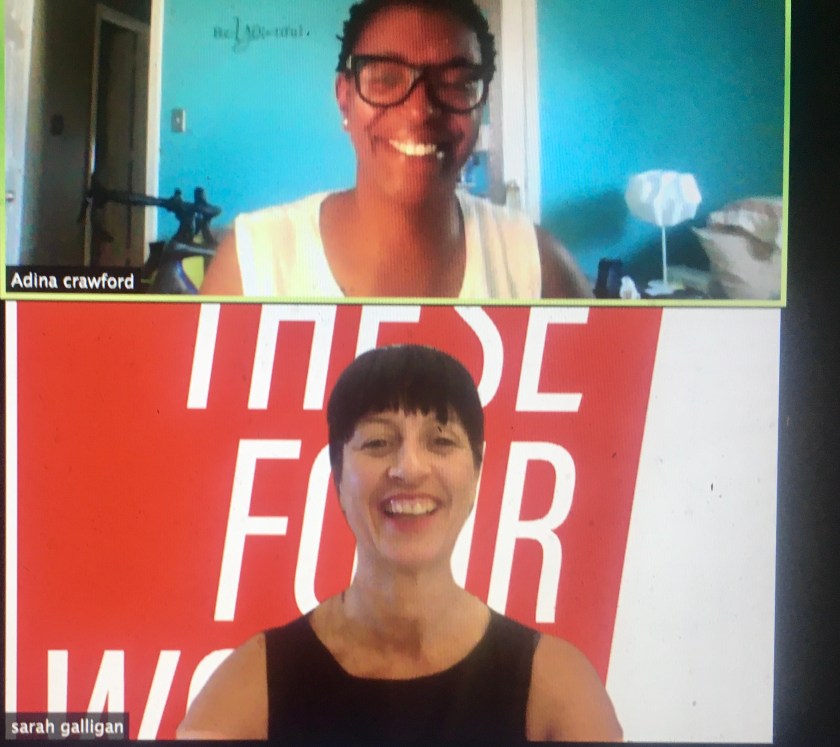
Adina Crawford from Black Girls Do Bikes and Sarah Galligan from These Four Words
Sarah is interviewing Adina Crawford (pictured with Sarah on a Zoom call) of US group Black Girls Do Bikes, Richard Hearne of Pride Out and Steve Scott from Dwarf Sports for a webinar on Diversity in Cycling on 15 October 2020 as part of a series of webinars for Trek Bikes. Join them.
New client – and what a client. I admire their values so much that it’s a pleasure to work with them!
Regeneration Brainery brings together young people with leaders from the property and construction industry – and you can take a listen to John, Mohamed and Melanie as they interview Ged Couser from architecture practice BDP on Wednesday 19 August at midday via the Movers & Shakers-hosted webinar.
It’s important to check because they change so when people ask me what banner sizes to use I guide them to sites that do their homework and keep things current.
So let’s start with a B2B basic: LinkedIn. Different rules depending on whether you are a person or a company.
If you are an individual: your profile picture should be 400 x 400 and should look like you – like you look today when you go to work – a little formal. Your background header image should be 1584 x 396 and should be fairly clean – you don’t want it to detract from your face. A banner bearing your logo or tagline works a treat.
If you are a company you should use your logo as your profile picture 300 x 300 and use a plain company cover image 1536 x 768. As Brandwatch points out, it’s odd as it will be mostly covered so keep it plain and don’t think about it for too long.
Posting on LinkedIn: 1200 x 1200 posts; videos min 256 x 144 px – 4096 x 2304 px max. Videos can be ten minutes but I recommend 2 1/2 minutes unless you are Madonna, Bill Gates or Meghan Markle.
On to Twitter: again profile picture 400 x 400 px. Use your LinkedIn profile if you use both for business for continuity. Your profile photo can be bland or give it some contrast and should be 1500 x 500 px.
Twitter posts demand an image: your post gets 150% more attention if you use an image. It’s not worth not adding one. 1024 x 512 px. Any videos should be SHORT. Twitter allows for 140 seconds but who watches a video for longer than 2 minutes? Keep it to 30 seconds and subtitle it. Size-wise pixel-wise use 720 x 720 (square), 1280 x 720 (landscape), 720 x 1280 (portrait).
I’ve started exploring Tik Tok. The best thing about working in communication is you’re always down with the kids. Profile picture 200 x 200; video size 1080 x 1920 px and keep your videos to 15 seconds. You can include links in your posts.
If you’re promoting an event, you’re likely to be using Eventbrite. Your event image will need to be 2160 x 1080 px JPEG, BMP, PNG or GIF no larger than 10 MB.
Facebook used to have different rules for business pages but not anymore. This means profile image 180 x 180 px, cover photo 820 x 312 630 px. I’m use FB events and run Facebook Lives and find I tend to have everything they want. I’ve been using standard high res photos for my event covers though official guidelines say 1920 x 1080 px. I’m loving video content – you can have up to 250 minutes – 240! Subtitle your videos if you can: every home and café is now a workspace:) Full guidelines from Facebook are here.
For many of us, 2020 has been a year of reassessing what our clients, our communities and ourselves care about.
One of the upsides of the Covid-19 pandemic seemed to be the rise in neighbourliness – until we were reminded that structurally we aren’t so neighbourly after all, what with the differences in who has to go to work, whose jobs are more at risk and whose lives are more at risk.
I have worked in social value for two decades, helping organisations communicate and demonstrate the value they bring to their clients and their communities. In that time I have had many conversations about diversity and whilst organisations desire to build a more diverse team and recognise the positive business benefits of diversifying their team, they find it hard to make the changes.
This week I joined a diverse group of passionate peers on the inaugeral Diversi-team panel hosted by Onno Consulting to discuss what changes do have impact. Jane Rapin discussed the equality in law, Omar Javaid discussed equality in recruitment processes and I discussed the way companies can use processes to change cultures and force us to have difficult conversations.
I look forward to attending future events run by Diversi-team and learning from others. Do connect if you’d like to be part of the conversation.
I had an interesting conversation with British Cycling road and TT coach Sue Allen last week.
We were talking about goal setting. Not for Olympians but for people like you and me. Or even you and me when we were kids. And for you and me in lockdown. These can be technical, mechanical or learning.
We’ll be talking about this on Thursday at 6 pm on Trek Women Manchester’s Zoom Cafe – let me know if you’d like the login details.
I’ve also had some thoughts about how goal setting can be dangerous for me. Ten years’ ago I made a three year career plan. Hit it in four. Then didn’t replan – well – for a while.
Last year I did the bike ride of my life. London – Cannes. Trained for five months. Fundraised so hard I won an award for it. (It helps when you really admire the charity (Coram) and used to head up new business for the corporate fundraising team of The Children’s Society.) Smashed the ride. And then came the come-down. And I didn’t replan.
So I will be talking to coach Sue Allen about how to ensure I don’t make this mistake a third time.
I know part of this is mindset rather than goals-orientation.
Its funny, with clients or team-members I’m great at keeping my eyes on larger goals. I must take my own advice. The communications calendars are full and aligned to their missions, their values and their aims.
Thank you Kathryn Eade from Up and Thrive for your many words of wisdom last year. I was dithering between the known and unknown and she continually challenged me that I had more control over the unknown – after all, I was making my path.
Preparing for the next Build Back Better webinar from Greater Manchester LEP on Thursday 4 June gives us an opportunity to reflect on the emerging steps to rebuild the economy in Greater Manchester.
How can we rebuild an economy where people come first? Not just any people, but all of Manchester’s people.
What do we need? Food. Housing. Sense of Purpose. Community. Security.
Mark Hughes MBE from the Growth Company joins Greater Manchester’s Mayor Andy Burnham and Lou Cordwell, Co-Chair of Greater Manchester LEP to discuss emerging thinking on Building Back Better, business engagement to date, how businesses can prepare and how we can build more socially aware businesses.
With the recession we are more careful in how we invest our time and our money. Supporting local businesses has been a theme of C19 for the people of Greater Manchester. They have rallied around local businesses to keep them afloat.
Greater Manchester boroughs had already committed to giving significant weighting to a company’s commitment to social value before awarding a contract. Now is the time for this resolve to be strengthened even further.
It’s no secret that I love cycling. I’ve used it for my daily commute in most places I’ve lived: growing up in my home village, Burtonwood, then in Manchester, Missouri, Cardiff, St Albans and Vancouver.
My London life was pre-cycle superhighway (and also perhaps a little fun-filled) for a safe bike commute so I took a break there, likewise in Australia where my love of the bus and a working ozone layer meant I didn’t brave a two-wheeled commute. Otherwise I suppose I’ve been pretty committed.
My bike doesn’t have a curfew. It’s taken me to gigs, black-tie dos and to weddings. (Bonus – it’s easier to cycle in heels than to walk in them.) Oh, and at weekends I dress in lycra and cycle some more.
I’m constantly told how brave I am for cycling. I don’t feel brave but as so many people tell me I am, I figure I must be.
But as Chris Boardman said, ‘You shouldn’t have to be brave to ride a bike or cross a road.’ And that’s why I’ve been vocal in the active travel movement for some time. People don’t always see cycling or walking as desirable ways to commute. There’s loads we can do to change this.
It starts with listening and understanding what people want in their lives and their commutes and once we’ve understood what the different desires and reservations are, we can respond to them, motivate them.
People need the capability, motivation and opportunity to change their behaviour and a good engagement program will address these factors. I’m fortunate to be an ambassador for Trek Bikes who are committed to getting more women on two-wheels. This means I get the opportunity to reach more women. At the moment we have a lot of new cyclists. Our aim is to keep them cycling in the long-term.
By listening to new riders and walkers about what they want to see more of in their neighbourhood, we’ll motivate them in the short-term. And by responding to their words, we’ll keep them motivated in the long-term.
The Government has passed legislation enabling local authorities to make emergency changes in infrastructure. This is the opportunity.
If you need advice on communicating the short-term and long-term benefits of active travel to your community – you should ring my bell!
Processing…
Success! You're on the list.
Whoops! There was an error and we couldn't process your subscription. Please reload the page and try again.
Running on-line events take as much effort as physical ones. They may not need catering, but they do demand careful structuring, scripting, preparation of speakers and confident hosting. And they need to be bloody interesting. And that means knowing your audience, and promoting your event appropriately. And then afterwards, everyone needs to be thanked.
Great crowd!
Ellen Holmes, Cycling UK
It can be trickier to read the room, but there are ways to manage this -just like at a physical event. Shorter presentations and more time for Q&A lets attendees ‘choose their own adventure’ and guide the conversation – just like a real café. When you’ve taken the time to get clever speakers, it’s great to let them lose. Online you may need to wait a little longer for people to take themselves off mute and ask their question – and they may need to be put at ease by the host asking a few first.
There was lots of interaction at Trek Manchester’s first Zoom Cycle Cafe in May 2020. Lots. Sarah Galligan, founder of These Four Words and Trek Advocate welcomed Beth Barrett, from British Cycling, Ellen Holmes from Cycling UK and Mildred Locke, from Trek Bristol to discuss active travel infrastructure, national and local campaigns and bike maintenance.
Beth talked about British Cycling’s remit – and whilst they are not busy running their normal events during the coronavirus lockdown, they have launched a national campaign, Let’s Ride Local and have initiatives to support key workers and have a Places to Ride funding pot welcoming applications for infrastructure and equipment right now!
Similarly, Ellen Holmes talked about their national campaign to improve cycling infrastructure in the UK as well as their community-focused initiatives supporting key workers who may wish to start cycling – and community groups more widely through their Big Bike Revival campaign.
Ellen also talked about mountain biking in Greater Manchester and beyond – there was a real ripple of interest in the 800 mile Great North Trail.
But what’s the use of a bike if it doesn’t work? Thankfully, Mildred Locke from Trek Bristol was on hand to answer key questions. What can you safely sort yourself? What tools should you invest in? What should you leave to a pro?
Mildred is a volunteer at Bristol Bike Project which is a member-led co-operative repairing and rehoming bicycles, often the kind of bikes you’ve had in your shed for 10 years – got any of those?
It whizzed by!
Judi G, road cyclist and attendee
You can probably understand why the event went over-time – people had so many questions for the three speakers, and due to lockdown, no-one had a long-commute home.